Ramzi Habibi: The Man Behind the Title, the Numbers, and the Name
In an era when financial executives chase public profiles as eagerly as returns, Ramzi Habibi has done the opposite — and built one of the more quietly impressive careers in American asset management.
His name rarely appears in the financial press. He gives no interviews. He holds no public social media accounts. Yet since 2008, he has worked his way from entry-level associate to Managing Director at Oaktree Capital Management, one of the most respected alternative investment firms on earth.
That story is worth telling in full.
Quick Bio
| Detail | Information |
| Full Name | Ramzi Habibi |
| Estimated Birth Years | 1980 or 1982 (unconfirmed; exact date not public) |
| Estimated Age (2026) | Early to mid-40s |
| Nationality | American |
| Ethnicity | Believed to have Middle Eastern roots |
| Education | B.S. Economics, Wharton School, University of Pennsylvania |
| Professional Credential | CFA Charterholder |
| Current Role | Managing Director, Global Private Debt — Oaktree Capital Management |
| Former Employer | Lehman Brothers (Investment Banking, Financial Sponsors Group) |
| Internships | SHUAA Capital, Dubai; PepsiCo, New York |
| Joined Oaktree | 2008 |
| Previous Oaktree Role | Co-Director of Research, U.S. High Yield Bond Group |
| Spouse | Masiela Lusha (married December 28, 2013) |
| Children | Landon (born February 2018), Arabella LeMont (born October 2020) |
| Residence | Los Angeles, California |
| Estimated Net Worth | ~$3 million (widely cited; not officially verified) |
| Social Media | No public accounts |
Why This Man Is Harder to Find Than He Should Be
Ask most people who Ramzi Habibi is, and they’ll tell you he’s Masiela Lusha’s husband.
That answer is accurate. It is also deeply incomplete.
Habibi holds a senior leadership position at Oaktree Capital Management — a firm that manages hundreds of billions of dollars globally and is owned by Brookfield Asset Management. Getting to Managing Director at such a firm takes years of relentless analytical work, credibility under pressure, and the trust of colleagues and clients alike.
He earned that title. It was not handed to him through connection or celebrity.
The fact that most of the internet knows him primarily as a spouse says more about how aggressively he guards his own privacy than it does about his actual standing in the world of finance.
See also “Chandler Belfort: The Quiet Daughter Who Chose a Different Kind of Power“
A Foundation Built Before the Spotlight
Habibi’s personal history before his professional life is almost entirely undisclosed.
His exact birth date is disputed across sources — some place it in October 1980, others in August 1982. He has never confirmed either. His birthplace, his parents, his siblings, his upbringing — all of it sits behind a wall of deliberate privacy.
What is confirmed is that he carries the CFA designation, which is awarded only after passing three grueling exams, accumulating significant professional experience, and committing to a strict code of ethics. Less than 20 percent of candidates who begin the CFA program ultimately complete it.
He also graduated from the Wharton School at the University of Pennsylvania — an institution that consistently ranks among the top two or three business schools on the planet. His major was economics, with concentrations in finance and operational and information management.
The combination of those credentials does not happen by accident. It points to someone who understood early what kind of career he was building — and pursued it with precision.

The Internship Years: Dubai and New York
Before any full-time role, Habibi accumulated international experience that many of his peers lacked.
He completed a summer internship at SHUAA Capital in Dubai, UAE — an investment bank and asset management group operating across the Middle East and North Africa. That placement gave him a window into cross-border capital markets, sovereign wealth dynamics, and emerging market credit at a formative age.
His second internship was at PepsiCo in New York, a completely different kind of environment — a massive consumer goods company with a global treasury and finance operation of its own.
Together, those two placements gave Habibi something valuable: exposure to both the institutional finance world and the corporate operational world, across two continents, before he had even graduated. It was a deliberate and well-sequenced foundation.
Lehman Brothers: High Stakes, Short Tenure, Long Lessons
Habibi’s first professional role after Wharton placed him at the center of one of the most dramatic collapses in financial history.
He joined Lehman Brothers as an investment banking analyst in the Financial Sponsors Group. That group works specifically with private equity firms — advising on leveraged buyouts, debt financing structures, and complex M&A transactions. The work demands speed, precision, and an ability to process enormous amounts of financial data under deal pressure.
He spent approximately two years there. Lehman Brothers filed for bankruptcy in September 2008 — the largest bankruptcy in American history. Habibi had left by then, joining Oaktree that same year. But the experience he gathered at Lehman — analyzing how large capital structures are assembled and how they fail — was almost certainly formative.
Watching a major institution collapse from the inside teaches lessons that no classroom replicates.

Oaktree Capital: Sixteen Years and Counting
In 2008, Habibi joined Oaktree Capital Management as an associate in the U.S. High Yield Bond group.
The timing deserves attention. He arrived just as global credit markets were seizing. The financial crisis was rewriting the rules of risk assessment, credit pricing, and institutional survival in real time. That environment — brutal for many, career-defining for those who navigated it well — became Habibi’s training ground.
Oaktree itself is significant. Founded by Howard Marks — one of the most widely respected investment thinkers of his generation — Oaktree built its reputation on distressed debt, credit, and the philosophy that risk control matters more than return-chasing. Marks’s quarterly memos on market psychology are read by investors worldwide.
Habibi spent over a decade in Oaktree’s High Yield Bond group, eventually serving as Co-Director of Research. That role means he wasn’t just analyzing investments — he was leading the team that did so. He supervised analysts, shaped research methodology, and bore responsibility for the intellectual rigor underpinning the group’s investment decisions.
Today, his title is Managing Director within Oaktree’s Global Private Debt strategy. That business — private credit — has become one of the fastest-growing corners of finance in the past decade. As traditional banks retreated from certain lending categories post-2008, firms like Oaktree stepped in to provide direct financing to mid-market companies. Habibi sits at a senior leadership level in that expansion.
Within professional circles, he is described as methodical, calm under volatility, and deeply research-driven. His approach mirrors Oaktree’s broader philosophy: thorough analysis before capital deployment, downside protection over speculative upside.
The CFA Designation: What It Actually Means
The Chartered Financial Analyst credential is frequently mentioned in Habibi’s public biography, and it warrants a moment of explanation.
The CFA program involves three sequential exams covering ethics, portfolio management, financial reporting, economics, derivatives, fixed income, and equity. The pass rate for Level I hovers around 40 percent in most years. Many candidates take four to six years to complete all three levels.
The designation is widely considered the global gold standard for investment professionals. Employers in the credit and asset management space treat it as a meaningful signal of analytical discipline and professional commitment.
That Habibi holds it — alongside his Wharton degree — rounds out a credential profile that is among the more substantial in his field.
The Man He Keeps Private: Personal Life
Habibi met actress and author Masiela Lusha in 2012. They moved quickly — he proposed in July 2013, just months after they began dating publicly.
On December 28, 2013, they married at Coromandel Peak in Wanaka, New Zealand — a location accessible only by helicopter, overlooking a lake, high above the clouds. The ceremony included only close family and the officiant. Lusha wore an embroidered gown detailed with dozens of small buttons across the back and a flowing train. Her hair was decorated with jeweled stars. After the ceremony, the group flew back to Queenstown for a private celebration.
The choice of location said something about both of them: stunning, but removed from cameras. Meaningful, but not for public consumption.
Their son, Landon, arrived in February 2018. Lusha later shared the story of a pregnancy scare — a sharp cramp that sent her to the emergency room, convinced something was wrong. Habibi left work immediately and met her there. It turned out she had pulled a muscle during play rehearsal. The child was fine. But the instinct to drop everything and show up told a quiet story about what kind of partner he is.
Their daughter, Arabella LeMont, was born in October 2020. Lusha described her arrival as “our little light has finally arrived.” She later mentioned reading poetry to Arabella — the same way Lusha’s own mother had read to her as a child.
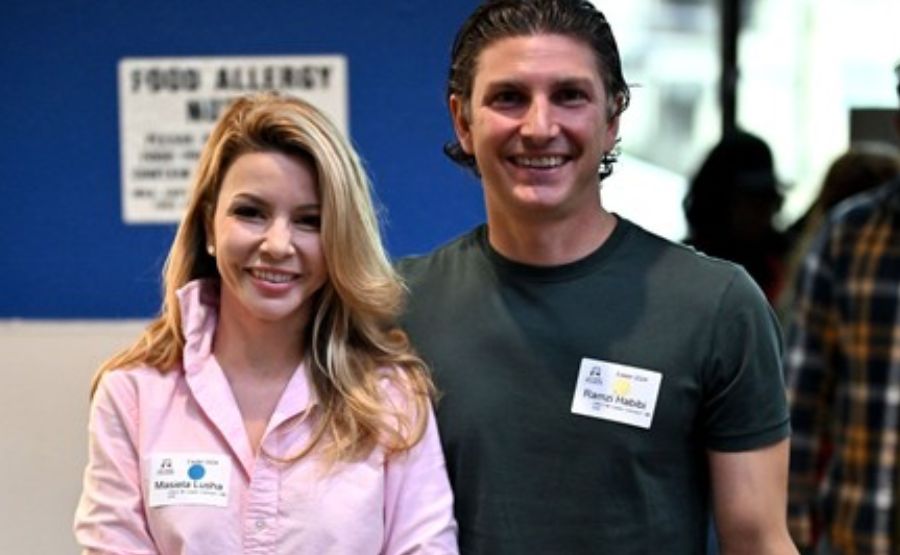
The family lives in Los Angeles. They are occasionally photographed together at charity events and red-carpet appearances — Habitat LA galas, humanitarian functions tied to Lusha’s work. Habibi stands beside her in those photos, present and calm. He doesn’t perform for the camera. He doesn’t need to.
The Spouse He Married: Masiela Lusha in Brief
No account of Ramzi Habibi would be complete without understanding the world his wife inhabits — because it could not be more different from his own.
Masiela Lusha was born in Albania in 1985. Her family fled to the United States as refugees. She broke into Hollywood as a teenager and played Carmen Lopez on the ABC sitcom George Lopez from 2002 to 2007 — a role that earned her consecutive Young Artist Awards. She later appeared in the Sharknado franchise alongside Ian Ziering, Tara Reid, and David Hasselhoff.
Beyond acting, she has published multiple books of poetry, worked as a UN Women advocate, served as a Goodwill Ambassador for the World Assembly of Youth, and was appointed ambassador for Prince Harry’s charity Sentebale in 2010.
Publicly, she is visible, vocal, and emotionally expressive. Her Instagram is active and personal. She writes about motherhood, poetry, and advocacy.
Her husband is none of those things — at least not publicly.
The contrast is pronounced. A finance executive who runs from cameras. An actress and poet who communicates through public expression. Somehow, it works.
Lusha has described Habibi as her “safe place” in social media posts marking anniversaries and family milestones. That framing — not glamorous, not performative, but honest — reflects how she speaks about him when she does speak.
Net Worth: The Number People Search For
Estimates of Habibi’s net worth vary across sources from roughly $1 million to over $3 million. Most settle around the $3 million figure.
There are no audited filings, no official disclosures, and no statements from Habibi himself. The number cited online is a reasonable estimate based on what a Managing Director at a firm of Oaktree’s scale might earn over a sixteen-year career — not a verified fact.
What is clear: Habibi earns his income through professional work, not through his wife’s career or inherited wealth. He is a senior executive at a globally significant firm. His compensation reflects that, without any confirmed breakdown.
What is equally clear: he does not use that wealth performatively. No visible luxury displays. No flashy lifestyle content. No branded presence. He lives in Los Angeles, raises two children, and keeps the details to himself.
Privacy as a Professional Choice
In finance — particularly at the senior levels of alternative asset management — a degree of discretion is expected and even valued.
Clients entrust firms like Oaktree with billions of dollars. The professionals who manage that capital are expected to be disciplined, measured, and serious. Public attention can complicate those relationships. Perception matters.
But Habibi’s privacy goes beyond institutional norms. He holds no LinkedIn posts, no public Twitter or Instagram, no interviews in financial media. His name appears in official company bios and in a handful of regulatory filings — that’s essentially it.
That is an active, sustained, deliberate choice. And it has been remarkably consistent across more than a decade of marriage to a public figure.
Most people in his position would have permitted at least some public exposure. He has permitted almost none.
The result is a gap between his actual professional significance and public awareness of it — a gap that, based on all available evidence, he engineered intentionally.
What His Career Actually Represents
Habibi’s trajectory is worth evaluating on its own terms, separate from his marriage.
He entered finance during one of its most turbulent periods. He joined a firm shaped by one of the discipline’s sharpest intellectual minds. He spent over a decade advancing through research leadership before reaching Managing Director — a title that, at Oaktree, carries real weight. He now oversees strategy in a segment of finance — private credit — that has grown from a niche specialty into a dominant institutional category.
That is not a minor career. That is a serious, sustained, professionally rigorous career built over two decades of consistent output.
What he has not done is use it to build a public persona, seek media attention, or leverage his spouse’s visibility for personal brand-building. In an era when professionals across every field rush to position themselves as thought leaders, content creators, and public intellectuals — Habibi simply works.
Whether that reflects professional temperament, cultural background, personal philosophy, or all three is not publicly known.
What is known is that it has worked.
Final Words
Ramzi Habibi is not a complicated figure to understand. He is a complicated figure to find.
He attended one of America’s top business schools. He earned one of the hardest designations in global finance. He built a sixteen-year career at a world-class investment firm. He married a woman who lives almost entirely in the public eye, and he did not let that pull him into it.
He is, by every measurable standard, genuinely accomplished. And he is almost aggressively uninterested in anyone knowing that.
There is something worth noting in that combination. In a culture that treats visibility as validation, his career reminds us that real expertise often operates far from the spotlight — in rooms where the work is technical, the stakes are real, and the results speak without a press release.
That may be the most honest summary of Ramzi Habibi: a man who does serious work, holds serious credentials, raises his children in a city full of cameras, and appears in almost none of them.
FAQs
1. What does Ramzi Habibi do for a living?
He is a Managing Director within the Global Private Debt strategy at Oaktree Capital Management, one of the world’s leading alternative investment firms. He previously served as Co-Director of Research in the firm’s U.S. High Yield Bond group.
2. Where did Ramzi Habibi go to school?
He earned a Bachelor of Science in Economics from the Wharton School at the University of Pennsylvania, with concentrations in finance and operational and information management. He also holds the CFA charterholder designation.
3. How long has Ramzi Habibi worked at Oaktree?
He joined Oaktree in 2008 as an associate. As of 2026, that represents approximately 17 to 18 years with the same firm.
4. What did he do before Oaktree?
He was employed by Lehman Brothers for two years as an investment banking analyst in the Financial Sponsors Group. He also completed internships at SHUAA Capital in Dubai and PepsiCo in New York.
5. Who is Ramzi Habibi married to?
He is married to Masiela Lusha, an Albanian-American actress, author, and humanitarian known for her role as Carmen Lopez in the ABC sitcom George Lopez. They married on December 28, 2013.
6. Where did they get married?
Their wedding took place atop Coromandel Peak in Wanaka, New Zealand. The guests, immediate family, and officiant were flown to the mountain by helicopter.
7. How many children do Ramzi and Masiela have?
Two. Their son Landon was born in February 2018, and their daughter Arabella LeMont was born in October 2020.
8. What is Ramzi Habibi’s estimated net worth?
Most sources estimate approximately $3 million, earned through his career in finance. This figure is not officially confirmed by any public disclosure or financial filing.
9. Is Ramzi Habibi on social media?
He doesn’t have any active social media profiles. He does not appear on Instagram, Twitter, LinkedIn publicly, or any other platform. Photos of him appear only occasionally through his wife’s Instagram page.
10. What is a CFA charterholder?
The Chartered Financial Analyst designation is awarded by the CFA Institute after candidates pass three rigorous exams covering investment analysis, portfolio management, ethics, and financial reporting. It is one of the most demanding and respected credentials in global finance.
11. What is Oaktree Capital Management?
Oaktree is a Los Angeles-based global asset management firm founded by Howard Marks. It specializes in alternative investments — particularly credit strategies including high-yield bonds, distressed debt, and private credit. The firm is owned by Brookfield Asset Management.
12. What is private debt, the area Habibi now leads?
Private debt refers to loans and credit facilities made directly to companies by investment funds — bypassing traditional banks. It has grown substantially since the 2008 financial crisis. Habibi’s current role focuses on structuring and overseeing these types of credit investments at a global scale.
Keep creating moments of inspiration with Signature Magazine every day.