Della Bea Robinson Ray Charles Wife: Her Quiet Role in Ray Charles’s Rise
Della Beatrice Howard Robinson matters in 2026 not because of who she married, but because of who she remained when that marriage was over.
She spent 22 years beside one of the most celebrated and most self-destructive musicians America has ever produced. She raised three sons largely alone while her husband toured the world and fathered children with other women. She filed for divorce in 1977 — quietly, without tabloid spectacle — and walked away from the spotlight with her dignity intact and an estimated $15 million in financial settlement.
She has not spoken publicly since.
That silence is not blankness. It is a story.
Quick Bio
| Category | Detail |
| Full Name | Della Beatrice Howard Robinson |
| Nickname | Bea (given by Ray Charles) |
| Born | 1929, Los Angeles, California, USA |
| Age (2026) | Approximately 96–97 years old |
| Nationality | American |
| Ethnicity | African-American |
| Religion | Christian |
| Early Education | School in Richmond, California (through 4th grade) |
| Profession | Gospel singer; homemaker |
| First Marriage | Unknown man (abusive; ended in divorce) |
| Second Marriage | Ray Charles Robinson (April 5, 1955 – 1977) |
| Marriage Duration | 22 years |
| Children with Ray Charles | Ray Charles Robinson Jr. (b. May 25, 1955), David Robinson (b. 1958), Robert Robinson (b. 1960) |
| Divorce Filed | 1976–1977 |
| Estimated Net Worth | ~$15 million |
| Primary Source of Wealth | Divorce settlement from Ray Charles |
| Ray Charles’s Estate at Death (2004) | ~$75 million |
| Current Residence | Reportedly Riverside County, California |
| Social Media | None |
| Current Status | Believed alive; entirely private |
Born Into Absence, Raised in Strength
The circumstances that shaped Della Bea Robinson began before she could form a memory of them.
She was born in 1929 in Los Angeles, California, to parents who were never married and who separated almost immediately after her birth. Her father left for Houston, where he remarried and built a separate life. Bea’s mother raised her alone, supplemented by the presence and support of her maternal grandmother.
Growing up on her maternal family’s eighty-acre farm gave Bea an early education in self-reliance. The land required work. The family required loyalty. Music — specifically gospel music — required something more difficult to define: faith in something that couldn’t be proven, only felt.
She attended school in Richmond, California, through the fourth grade. After that, family responsibilities took over. This was not uncommon for Black girls in 1930s and 1940s America — education was a luxury that yielded to domestic need. What Bea lacked in formal schooling she compensated for in something harder to teach: character.
The church became her classroom in the years that followed.
See also “Dylan Tays Today: The Woman Who Walked Away from Hollywood“
The Gospel Singer Before the Famous Marriage
Before a single headline ever connected her name to Ray Charles, Della Bea Robinson was building her own musical identity.
As a teenager, she joined Cecil Shaw’s church choir — a decision that placed her at the intersection of community, performance, and spiritual expression. The choir was not a casual hobby. They performed in churches across the region, appeared on radio broadcasts, and gave concerts that drew genuine audiences.
Her voice carried. People noticed.
That early recognition led to a recording deal, and Bea produced songs that were pressed onto records and sold within her community. The scale was local, not national. But the accomplishment was real — a young woman from a fatherless household had developed professional artistic credibility before the age of 30, entirely on her own effort.
Then she met Ray Charles. And the trajectory changed.
It would be too simple to say she sacrificed her career for the marriage. The truth is more layered. Gospel singing was her vocation, but family became her mission. Whether that shift was a sacrifice or a choice — or both simultaneously — is something only Bea knows. She has never said that.
The Meeting That Changed Everything: Texas, 1954
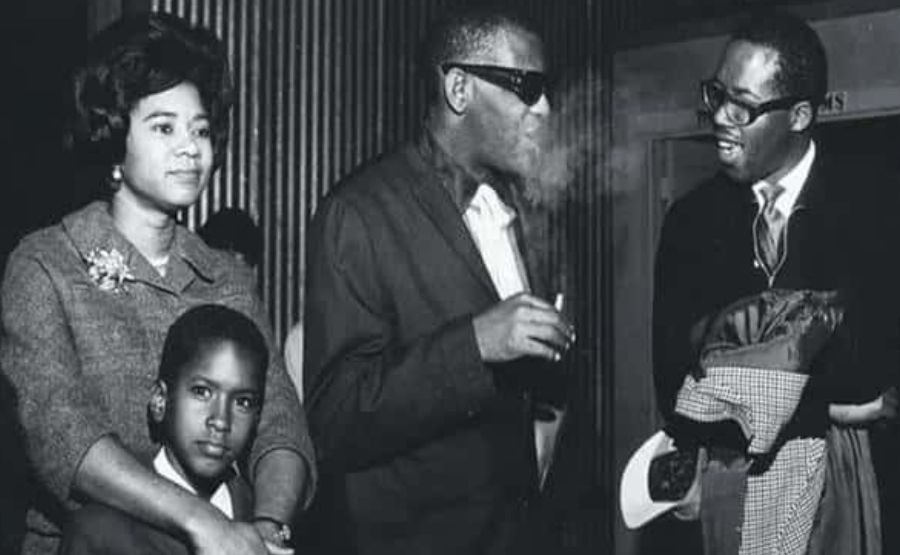
Ray Charles Robinson and Della Beatrice Howard first crossed paths in Texas in 1954.
Ray was 23 years old and already building momentum. He had recorded his earliest Atlantic Records material and was beginning to draw audiences at Black venues across the American South and Southwest. He was also already deeply embedded in heroin addiction, already cycling through extramarital entanglements, and already showing the brilliant instability that would define his public story.
Bea was in her mid-twenties and thriving in her gospel music work. She later recalled — in the few accounts that exist of her perspective — that she kept encountering Ray on the road in what felt like coincidence. It was not. He was finding reasons to be where she was.
They began a relationship. Within months, they decided to marry.
The wedding took place on April 5, 1955, in Dallas, Texas, in a cluttered back room with a stranger officiating. No elegant venue. No ceremony to remember. A woman neither of them knew read them their vows surrounded by junk that hadn’t found a better home. It was the beginning of 22 years.
Ray Charles was not in town six weeks later when their first son, Ray Charles Robinson Jr., was born on May 25, 1955. He was playing a show in Texas. The pattern was established early.
Twenty-Two Years: What Bea Held Together
The public narrative of Della Bea Robinson’s marriage to Ray Charles tends to reduce her role to suffering — the long-suffering wife of a genius who couldn’t keep his vows. That framing is incomplete and unfair.
Bea ran a household. She raised three sons. She built the domestic architecture inside which Ray Charles had something real to return to.
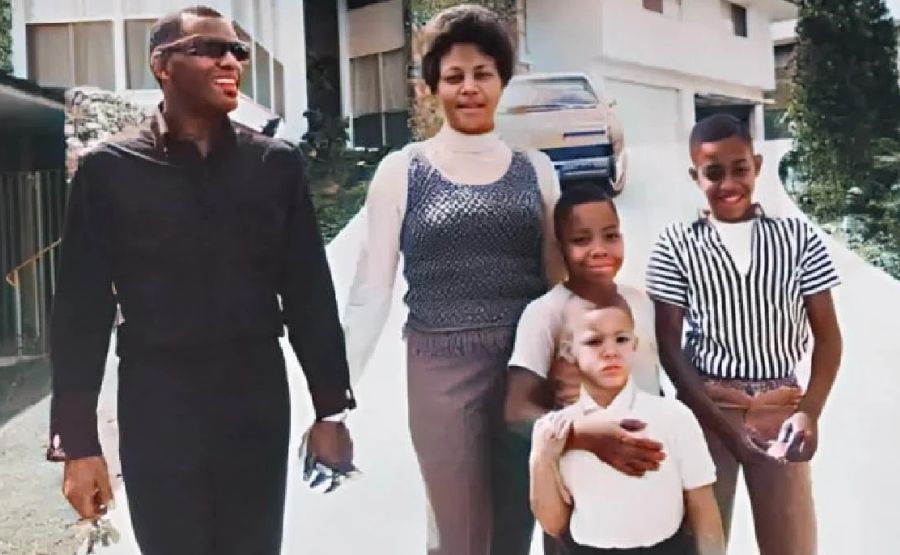
Ray Charles Robinson Jr. was born in May 1955. David Robinson arrived in 1958. Robert Robinson, the youngest, came in 1960. Three boys across five years — three children who needed a present parent while their father was absent across concert halls from New York to Europe.
They raised their family in View Park, California, a middle-class Black neighborhood on the west side of Los Angeles that represented aspiration and stability. The choice of neighborhood reflected Bea’s priorities: roots, community, a normal life for children who were anything but ordinary in their parentage.
Ray Charles credited her, in his autobiography and in interviews, with providing him something he genuinely struggled to provide himself: constancy. He called her “Bea” — a name he gave her that stuck. The affection was real. But affection did not make him faithful, and love did not make him present.
Publicly, Ray Charles was a pioneering genius. Inside the marriage, Bea lived with a heroin addict who fathered children with at least three other women during their years together — Margie Hendricks in 1959, Mae Mosley Lyles in 1961, and Sandra Jean Betts in 1963. Ray’s total child count reached twelve across a decade when he was still a married man.
The Affairs, the Addiction, and the Raelettes
Ray Charles’s affair with Margie Hendricks deserves specific mention because it cuts to the center of what Bea endured.
Margie Hendricks was one of the original Raelettes — the female vocal group Ray assembled and toured with. She and Ray had a six-year intimate relationship that produced a son, Charles Wayne Hendricks, born October 1, 1959. This was not a brief indiscretion. It was a sustained parallel relationship conducted while Bea raised their children in View Park.
Mae Mosley Lyles, also a Raelettes member, had a daughter, Renee, with Ray in 1961.
Bea was fully aware that the women performing beside her husband on stage were also sharing his personal life off it. She endured this knowledge and continued to maintain the family for years afterward. Whether this reflected patience, faith, practicality, or all three — only she could answer that honestly.
Ray’s heroin addiction ran alongside the infidelity as a second source of ongoing crisis. His 1961 arrest in Indiana brought his drug dependency into public view. He entered rehabilitation in 1965. His family — Bea, their three boys, the household she maintained — formed part of what he cited as motivation to fight his way through that process.
He got clean. The marriage continued. But the fundamental problems did not resolve.
The Divorce: Filed in 1976, Final in 1977
Della Bea Robinson filed for divorce in 1976. The proceedings concluded in 1977.
There were no dramatic press statements. No public accusations. No tabloid war. The divorce was handled with the same quiet dignity that characterized Bea’s entire approach to public life — which is to say, it was handled almost entirely outside of public view.
The specifics of the settlement were never disclosed. What has been reported consistently across multiple biographical sources is an estimated $15 million figure attached to Bea’s post-divorce financial position. The terms, the exact provisions, the negotiating process — none of this has ever been made public.
Ray Charles’s estate was valued at approximately $75 million at the time of his death in June 2004. By that point, he and Bea had been divorced for 27 years. She was not a beneficiary of his will. His estate distributed $500,000 to each of his 12 children and directed significant resources toward his charitable foundation focused on hearing loss research and music education.
The $15 million figure attributed to Bea represents what was settled between them in 1977 — a negotiated amount, presumably based on the legal standards of California divorce law, the length of the marriage, her contributions to the household, and whatever leverage or goodwill shaped the final number.
Net Worth: The $15 Million Question
The estimated net worth of $15 million attached to Della Bea Robinson requires honest examination.
First, the number’s origin: it traces back to the divorce settlement from 1977. No source has produced documentation of that settlement’s specific terms. The $15 million figure circulates across biographical coverage without a traceable primary source. It may be accurate. It may be an approximation. It may be extrapolated from assessments of Ray Charles’s wealth at the time.
Second, the context: in 1977, $15 million was a substantial sum. In 2026 dollars, accounting for nearly five decades of inflation, that figure would represent approximately $75–80 million in purchasing power — a genuinely significant financial foundation.
Third, the caveat: Della Bea has never confirmed, denied, or commented on her net worth. She is a private individual who has given no interviews and made no public financial disclosures. The $15 million figure is the biographical community’s best estimate, not a verified number.
What can be said with confidence: she received a meaningful settlement from a man with enormous earnings. She managed those resources quietly and carefully enough to live in Riverside County, California, for decades without public financial difficulty. She has not sought additional income through interviews, memoir deals, or celebrity appearances. Whatever she received, she preserved it through discretion rather than spending it through performance.
That restraint is its own kind of financial wisdom.
The Previous Marriages: Context the Headlines Miss
Most biographical coverage of Della Bea Robinson begins with Ray Charles. Her story began earlier than that — and harder.
Before she married Ray Charles, Bea had been married at least twice. Her first marriage — to a man whose name she has never disclosed publicly — was marked by physical abuse. He was violent when unhappy. The situation became dangerous enough that Bea left him and relocated to seek safety.
That experience — surviving domestic violence as a young woman in 1940s or early 1950s America, when institutional resources for abused women were virtually nonexistent — speaks to both the difficulty of her early life and the personal strength she brought into her relationship with Ray Charles.
Her second marriage, before Ray, also ended in divorce. Details of that relationship have never been made public.
This history matters for understanding who Bea was when Ray Charles found her in Texas in 1954. She was not a sheltered young woman encountering adult hardship for the first time. She had already survived two failed marriages, one of them violent. She had already rebuilt herself twice. She had a career, a voice, and the kind of hard-won self-knowledge that comes from real adversity.
When she chose Ray Charles, she chose him with open eyes.
The Portrayed Version: Jamie Foxx, Kerry Washington, and What Hollywood Got Right and Wrong
The 2004 biographical film Ray, directed by Taylor Hackford and starring Jamie Foxx as Ray Charles, brought Bea Robinson’s story to a global audience in a way no written biography had.
Kerry Washington portrayed Bea in the film — a portrayal that captured something of her quiet authority and dignified endurance without being able to fully render the complexity of 22 years of marriage.
The film presented Bea primarily through the lens of Ray’s story — she appears as the grounding force, the wronged wife, the woman who ultimately walked away. That is accurate as far as it goes. But it is, necessarily, incomplete.
What the film could not convey was the inner life of a woman who had already survived abuse, built a professional music career, and arrived at that marriage with more experience and harder-won strength than most portrayals credit her with. Bea was not simply a victim of Ray Charles. She was a full person who made choices, absorbed consequences, and ultimately determined her own exit.
Ray Charles himself reportedly approved of the project before his death in June 2004, the same year the film was released. He never saw it in theaters.
After the Divorce: Riverside County and Radical Privacy
Following the 1977 divorce, Della Bea Robinson relocated to Riverside County, California, and largely disappeared from public view.
She did not write a book. She did not grant interviews. She did not appear at Ray Charles tribute events or speak at his funeral in June 2004, which was held at the First African Methodist Episcopal Church of Los Angeles.
Her three sons have maintained their own public profiles at varying levels. Ray Charles Robinson Jr. has spoken about his father in interviews. Robert Robinson became Reverend Robert Robinson. David Robinson has maintained a lower profile. Their mother’s influence on their characters — her insistence on stability, faith, and quiet dignity — runs through the public accounts that do exist.
As of 2026, Della Bea Robinson is believed to be alive. She would be approximately 96 or 97 years old. No credible report of her death has emerged. No credible report of her re-emergence into public life has emerged either.
She remains, as she has chosen to remain for nearly five decades: completely, deliberately, and perhaps contentedly private.
The Larger Legacy: What Bea Robinson Built That Lasted
Historians of American music tend to measure Ray Charles’s legacy through discography, chart positions, Grammy counts, and the musicians he influenced.
Seventeen Grammy wins. The Grammy Lifetime Achievement Award. The Presidential Medal of Freedom. The Grammy Hall of Fame. A Polar Music Award from the King and Queen of Sweden. These are Ray Charles’s public monuments.
Della Bea Robinson’s legacy is less legible but no less real.
She created the domestic conditions inside which Ray Charles functioned for 22 of his most productive years — the years he recorded Modern Sounds in Country and Western Music, the years he crossed genre barriers that American music hadn’t crossed before, the years he became not just famous but genuinely historic.
She raised three sons who grew into men who have spoken about their mother with admiration and love. She managed a household through addiction, infidelity, extended absences, and national fame without losing her own compass.
And she walked away when she needed to — not in anger, not in public, but with the deliberate steadiness of someone who had always known exactly who she was beneath the famous last name she carried.
Final Words
Della Beatrice Howard Robinson will be approximately 97 years old in 2026.
She lives, by all available accounts, in Riverside County, California. She has not spoken to the press in nearly five decades. She has not monetized her proximity to one of America’s most famous musicians. She has not written a memoir, accepted a television interview, or attended a Ray Charles tribute in any documented capacity.
The $15 million divorce settlement that defines most public discussions of her net worth was secured in 1977 — a financial foundation built from 22 years of marriage to a man who was brilliant, infuriating, unfaithful, genuinely dangerous to himself, and nonetheless undeniably transformative in American cultural history.
She loved him. She endured him. She left him.
Then she spent the next 49 years living as if the world’s curiosity about her was not her problem to manage.
That is not a minor achievement. That is life.
FAQ: Della Bea Robinson — 15 Real Questions Answered
1. What is Della Bea Robinson’s estimated net worth in 2026?
Her estimated net worth is approximately $15 million. This figure is attributed entirely to the divorce settlement she received when her 22-year marriage to Ray Charles legally ended in 1977. She has never publicly confirmed or commented on this number, and the figure circulates without a verifiable primary source.
2. Did Della Bea Robinson receive any part of Ray Charles’s estate when he died in 2004?
No. Ray Charles and Bea had been divorced since 1977 — 27 years before his death on June 10, 2004. His estate, valued at approximately $75 million, was distributed among his 12 children ($500,000 each) and his charitable foundation focused on hearing loss and music education. Bea was not included.
3. When and where did Della Bea Robinson marry Ray Charles?
They married on April 5, 1955, in Dallas, Texas. The ceremony took place in a cluttered back room with a woman neither of them knew officiating. It was modest by any measure — the beginning of a union that would last more than two decades.
4. How many children did Della Bea and Ray Charles have together?
Three sons. Ray Charles Robinson Jr., born May 25, 1955. David Robinson, born 1958. Robert Robinson, born 1960. Their youngest son, Robert, became Reverend Robert Robinson. Ray Charles was absent at his eldest son’s birth, playing a show in Texas.
5. Why did Della Bea divorce Ray Charles?
She filed for divorce in 1976, with the proceedings concluding in 1977. The marriage had broken down under the weight of Ray Charles’s prolonged heroin addiction, repeated infidelity — he fathered at least nine other children with multiple women during their marriage — and volatile behavior. She endured this for over two decades before choosing to leave.
6. Was Della Bea Robinson a professional singer before marrying Ray Charles?
Yes. She was a gospel singer who performed with Cecil Shaw’s church choir — appearing in churches, on radio, and at concerts. She secured a recording deal and produced songs that were distributed on record. She gave up that career after marrying Ray Charles to focus on raising their children.
7. Was Ray Charles the first man Della Bea Robinson married?
No. She had been married at least twice before Ray Charles. Her first marriage was marked by physical abuse — her husband became violent, and she left him for safety. Her second marriage also ended in divorce. She entered the relationship with Ray Charles as a woman who had already survived significant personal hardship.
8. How is Della Bea Robinson portrayed in the 2004 film Ray?
Kerry Washington portrayed her in the Taylor Hackford-directed biopic starring Jamie Foxx as Ray Charles. The film captures her dignity and quiet endurance accurately but necessarily presents her through the lens of Ray’s story rather than her own.
9. Where does Della Bea Robinson live today?
She is reported to live in Riverside County, California, where she relocated after her divorce from Ray Charles in 1977. She maintains no public profile and has not made any documented public appearances in decades.
10. How old is Della Bea Robinson in 2026?
She was born in 1929, which makes her approximately 96 or 97 years old in 2026. She is believed to be alive, as no credible report of her death has been published.
11. Did Ray Charles acknowledge the impact of his behavior on Bea during their marriage?
Yes. In his autobiography and in interviews, Ray Charles acknowledged that his heroin addiction “took a toll” on Della during their marriage. He also credited his family — implicitly including Bea — as part of what motivated him to pursue rehabilitation in 1965.
12. Did Della Bea Robinson ever remarry after the divorce from Ray Charles?
No confirmed reports of any subsequent marriage exist. She has remained single since the 1977 divorce, at least as far as any public record extends.
13. Was the divorce settlement from Ray Charles the only source of Della Bea’s wealth?
All available evidence points to the divorce settlement as the primary source. She did not pursue income through media appearances, memoir deals, celebrity engagements, or commercial opportunities connected to Ray Charles’s legacy. Whatever she received, she preserved through a private life rather than growing through public performance.
14. How many children did Ray Charles have in total, and how many were born during his marriage to Bea?
Ray Charles fathered 12 children across 10 different women. Three of those children — Ray Jr., David, and Robert — were born within his marriage to Bea. The other nine were born through relationships with other women, several of which occurred while he was still married to Bea.
15. What is Della Bea Robinson’s lasting significance beyond her marriage to Ray Charles?
She represents something specific and rare: a woman who stood inside one of American music’s most famous marriages, absorbed decades of genuine hardship, walked away with her integrity, and then spent nearly 50 years living proof that proximity to fame does not require submission to it. Her refusal to capitalize on Ray Charles’s name — through no public statement, book, or interview — is itself a form of dignity that deserves recognition on its own terms.
Keep creating moments of inspiration with Signature Magazine every day.